
Inside the Booming Asian Stablecoin Adoption
The conventional narrative about Asia and stablecoins often goes something like this: regulators are cautious, capital controls are tight, CBDCs are the preferred path, and private stablecoins face an uphill battle against entrenched monetary sovereignty concerns.
It's a reasonable reading of the region's history. However, it is no longer an accurate reading of the present.
The Numbers That Forced the Pivot
The global stablecoin market cap stands at approximately $300 billion as of early 2026, reflecting an average annual growth rate of roughly 750% since 2018. Yet about 99% of this market is pegged to the US dollar. Asia's regulatory establishment spent years trying to prevent exactly this outcome. It didn't work, and the more interesting story now is what they're doing instead — and why the pivot matters for everyone operating in this space.
The Asia-Pacific region is now the fastest-growing area for on-chain crypto activity, posting a 69% year-over-year increase in value received in the twelve months to June 2025. That's not a rounding error, though. For context, Latin America — historically the region most associated with stablecoin-driven adoption — grew 63% over the same period.
South Asia alone saw stablecoin-driven crypto volumes rise 80% to $300 billion between January and July 2025. Globally, stablecoins now comprise 30% of all on-chain crypto transaction volume, recording their highest annual volume in August 2025 at over $4 trillion for the year — an 83% increase on the same period in 2024.
These numbers didn't arrive because Asian regulators waved them through, but made it despite regulatory ambiguity, capital control frameworks, and in some cases, outright hostility from central banks. The demand was structural and driven by cross-border trade corridors, remittance flows, and a regional FX infrastructure that charges 80–150 basis points per transaction for the privilege of being slow. Stablecoin remittances and P2P payments hit a $19 billion annualized run rate as of August 2025, with an average transfer size of $47 on stablecoin platforms versus $250 for traditional remittance channels.
The thing is, when the product is 5x cheaper and runs 24/7, adoption doesn't wait for regulatory approval. It builds quietly until the numbers become too large to ignore.
How Asia Stopped Fighting and Started Legislating
The strategic pivot across major Asian jurisdictions followed a recognizable sequence: resist, observe, acknowledge, regulate. Most of the region is now in the final stage, and the pace of framework development in 2025 and early 2026 has been notable.
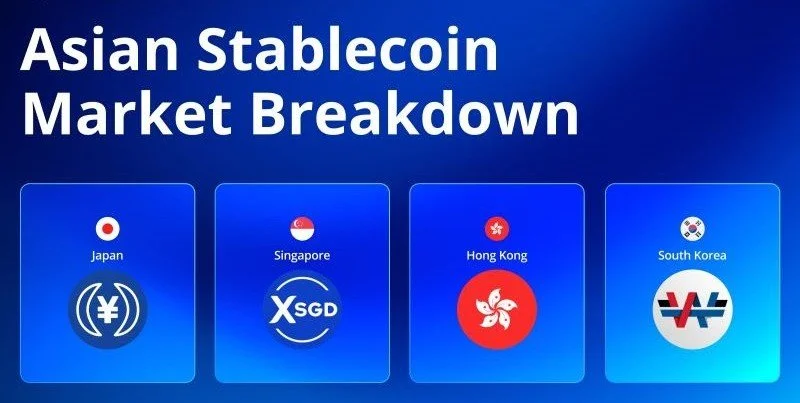
Hong Kong moved fastest and most decisively. Back on May 21, 2025, the Hong Kong Legislative Council passed the Stablecoins Ordinance, establishing a comprehensive regulatory regime for stablecoin issuance, and the framework came into effect on August 1, 2025. Under the new regime, stablecoin issuers must maintain HK$25 million in paid-up share capital, HK$3 million in liquid capital, and excess liquid capital covering at least 12 months of operating expenses. Moreover, stablecoins must be 100% backed by high-quality liquid assets with reserves segregated from corporate assets and shielded from creditors. First stablecoin licenses are expected in 2026, with initial approvals focusing on B2B applications — like trade settlement, remittances, and corporate treasury.
The significance of the HKMA framework extends beyond compliance mechanics, since ot is the first major Asian regime to permit licensed stablecoin issuers to offer retail access — making Hong Kong the only jurisdiction in the region where a regulated, retail-accessible HKD-pegged stablecoin can legally exist. That milestone represents a market structure decision that determines whether stablecoins integrate into everyday commerce or remain an institutional product.
Singapore operates through the Monetary Authority of Singapore's Major Payment Institution licensing framework, which has attracted a cohort of serious operators using the city-state as their Asia-Pacific base. Paxos Digital Singapore — the regional subsidiary of PayPal's stablecoin issuer — received its full MPI license in July 2024 and selected DBS Bank as its reserve custodian, with a Singapore-issued USD stablecoin planned for 2026. Singapore is building the regulatory infrastructure that lets global operators serve the regional market through a single, trusted jurisdiction.
South Korea is the outlier — and its situation is instructive. The country remains the only major Asian jurisdiction without a dedicated stablecoin law as of Q2 2026, meaning no KRW-pegged stablecoin has received regulatory approval. But the market is ready and waiting: the Naver Pay/Upbit consortium and Kakao Bank are both positioned to launch stablecoins immediately once legislation is in place. The Digital Asset Basic Act, passed in 2025, provides the framework Phase 2 legislation covering stablecoins specifically is the active battleground. The Korean situation is a preview of what rapid market formation looks like the moment a regulatory gate opens.
Asian Stablecoin Market Breakdown
Asian Stablecoin Market Breakdown
The Dollar Dominance Problem — And What Asia Is Actually Doing About It
Here is where the contrarian read matters most. The near-universal narrative in Asian policy circles is that USD stablecoin dominance represents a monetary sovereignty threat — dollar-ization of digital payments, capital flight risk, and erosion of central bank transmission mechanisms. That concern is legitimate since 99% of the global stablecoinmarket is pegged to the US dollar, and Asian central banks know exactly what that means for their ability to manage local monetary conditions.
But the policy response has shifted: rather than blocking USD stablecoins — which the data shows doesn't work — Asian jurisdictions are pursuing a two-track strategy: regulate and license USD stablecoins to capture tax revenue and AML compliance, while simultaneously building the infrastructure for local-currency alternatives. Q2 2025 already saw 258,000 transactions in non-USD stablecoins in Southeast Asia alone, with SGD-pegged instruments making up 70.1% of that non-USD volume.
The competitive pressure is real as regulatory uncertainty remains a major concern for 81% of Asian corporates exploring stablecoin adoption — higher than any other region surveyed. But the same report found that 54% of financial institutions and corporates not currently using stablecoins expect to begin doing so within six to twelve months, with supportive legislation increasing interest for 81% of corporates.
The Trade Finance Angle Nobody Is Talking About Enough
The remittance and retail payment story is well-covered, while the trade finance story is not, and it's arguably more structurally significant for Asia specifically.
Asia and Pacific cross-border stablecoin transactions average approximately $11,493 per transaction — a figure that reflects the B2B and trade settlement use cases dominating regional flows, rather than retail remittances. Asia's intra-regional trade corridors, like Singapore to Jakarta, Hong Kong to Shanghai, Manila to Tokyo, involve enormous volumes of USD-denominated settlement running through correspondent banking chains that charge 1–3% in friction costs and settle in T+2 at best.
Stablecoins eliminate both the cost and the settlement lag: Asia is running a relay fueled by trade flows, in Fireblocks' framing from their 2025 stablecoin payments report — and the relay is accelerating because the beneficiaries are import/export businesses operating on thin margins where 200 basis points in FX spread is the difference between a profitable quarter and a break-even one.
Cross-border payments remain the most interesting use case for 77% of corporates exploring stablecoin adoption, driven primarily by a reduction in transaction costs. In Asia's trade-heavy economies, that percentage likely runs higher still.
The stablecoin adoption in Asia is on the rise
The Clock Is Already Running
Every major Asian jurisdiction has a stablecoin position now. None of them has meaningful local-currency stablecoin volume. Combined, Asian-currency stablecoins represent less than 1% of a $300 billion market that is consolidating around the dollar faster than any of them are moving.
This is the structural risk that policy documents don't say plainly: dollar stablecoin infrastructure doesn't wait. Circle's on-chain FX platform ARC, cross-border B2B rails, AI agent payment networks — all of it is being built with USD as the base layer. Liquidity concentrates around the currencies that show up first. Joining after the network has hardened is a fundamentally different game.
Local-currency stablecoins carry an inherent tension — the moment they go on-chain, conversion paths to the dollar open beside them. Move too fast without the right institutional guardrails, and you accelerate the capital outflows you were trying to prevent. That's a real concern, and Asian regulators are right to take it seriously.
What happens next is the institutionalization of stablecoin infrastructure into corporate treasury operations, trade settlement workflows, and payroll systems across the region. 56% of financial institutions believe 5–10% of global cross-border payment value will be conducted using stablecoins by 2030— representing $2.1 to $4.2 trillion in annual flow.
Asia, given its trade volumes, its remittance corridors, and its accelerating regulatory clarity, will capture a disproportionate share of that. The region that spent five years trying to slow stablecoin adoption has spent the last eighteen months building the infrastructure to lead it.
Visit our website I Follow us on X I Join the Telegram Community
This article is intended for general informational purposes and should not be construed as financial, investment, or legal advice.