
Opening the Top 2026 Stablecoin Opportunity
Here's a question most stablecoin holders never ask themselves: What is my USDC actually doing right now? The answer, for the vast majority, is nothing.
This is the stablecoin paradox: the asset class that has become the backbone of on-chain finance is also, for most of its holders, completely inert. But it doesn't have to be.
The Illusion of Safety
To understand the opportunity, you first have to grasp just how much stablecoin capital exists — and how much of it is doing nothing.
The total stablecoin market capitalisation surged 49% in 2025, according to DeFi Llama. As of March 2026, the figure sits above $316 billion and continues to climb — but the overwhelming majority of that capital is parked, passive, and unproductive.
Meanwhile, consider what these same digital dollars are capable of! Stablecoins processed $46 trillion in total transaction volume in 2025, up 106% from the year prior — nearly three times Visa's annual volume, according to a16z's State of Crypto 2025 report. On an adjusted basis, filtering out bots and artificial volume, stablecoins still moved $9 trillion, up 87% year-on-year.
Therefore, we assume the rails work, and the capital is there, but the only missing ingredient is direction. How can we find the right one?
What Idle Really Means
Inflation doesn't care that your asset is stable, and opportunity cost doesn't care that you feel protected. Every month your stablecoins sit idle, the gap between what you're earning and what you could be earning widens a little further.
Let's be more precise about the cost of doing nothing. A dollar held in USDC earns 0% by default. Meanwhile, tokenized U.S. Treasury products, the most conservative on-chain yield option available, were offering annualised returns of 4–5% throughout 2025. Tokenized Treasury products allow crypto investors to earn reliable 4–5% annual yields with minimal risk, a compelling alternative to volatile DeFi yield farming.
Move one step further into tokenized private credit — such as structured, asset-backed debt instruments issued on-chain — and yields climb considerably higher, typically in the 8–15% range depending on the underlying asset, duration, and jurisdiction.
The gap between 0% and 8% on a $100,000 position is $8,000 per year. On a $1 million position, it's $80,000. Quite the measurable cost of inaction.
"In contrast to fiat-backed stablecoins that remain dormant, RWA-backed instruments transmit profits from yield-generating assets directly to token holders." —SolULab Research, February 2026
The Spectrum of Options
Not all stablecoin yield is equal. Beyond the numbers, you should do your research and choose reputation and safety over hype and skyrocketing numbers. Here is how the landscape actually breaks down, from conservative to growth-oriented:
1) Tokenized Money Market Funds & Treasuries
The lowest-risk entry point. Products like BlackRock's BUIDL and Franklin Templeton's BENJI fund offer on-chain exposure to U.S. government securities. By the end of 2025, tokenized U.S. Treasury products surpassed $7.4 billion, up roughly 80% year-to-date, reflecting demand from funds, corporates, and crypto-native treasuries seeking on-chain yield and instant settlement collateral. Yields are modest but real, and the risk profile is institutional-grade.
2) Tokenized Private Credit
The more compelling opportunity, and Metafyed's core focus. Private credit instruments — loans to businesses, structured debt, receivables financing — are being tokenized and made accessible to investors who previously had no route in. Private markets and credit projects control over 50% of the RWA sector (minus stablecoins), opening access for fundraising and alternative markets that were once restricted to institutions and high-net-worth individuals. Yields are meaningfully higher, and the assets are backed by real economic activity.
3) Yield-Bearing Stablecoins
The newest category is stablecoins structurally designed to pass yield back to holders. Rather than holding a standard stablecoin and then separately seeking yield, these instruments bake the return in from the start. Beyond Treasuries, private credit and other income-generating assets are also being tokenized — including loans to businesses, real estate debt, and other forms of credit — providing a more predictable and sustainable source of returns.
Source: Triple-A
Why Asia Is the Right Place to Deploy
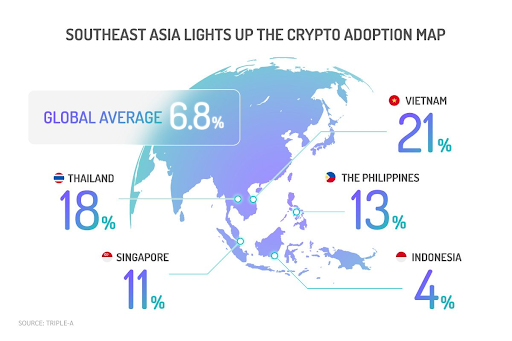
The stablecoin yield opportunity is global, but Asia-based holders face a specific, compounding version of the problem along with a specific, emerging solution.
This sector holds enormous concentrations of stablecoin capital. Hong Kong and Singapore are two of the deepest pools of digital asset wealth in the world. Much of that capital flows in from institutional desks, family offices, and crypto-native treasuries — and much of it sits idle, waiting for a credible, regulated yield destination.
At the same time, Asia's private credit market is structurally underfinanced. The region's SMEs, mid-market borrowers, and infrastructure projects are credit-hungry, and the traditional banking system isn't meeting that need. The result is a genuine yield opportunity, such as real assets with real demand for capital, that has historically been locked behind institutional barriers.
Tokenization dissolves those barriers. A Singapore-based holder of USDT can now deploy capital into a tokenized debt instrument backed by an Asian borrower, earn a structured yield, and settle everything on-chain without intermediaries, or a minimum commitment of $1 million, along with a three-month waiting period for the paperwork.
This is the infrastructure Metafyed has built: our advanced blockchain platform is an Asian-regulated RWA tokenization vehicle that connects holders of idle stablecoin capital with vetted, tokenized private credit opportunities originating from across the region.
Every deal on the platform goes through AI-powered research and KYC/AML scoring, smart contract structuring, and full on-chain settlement — which means investors get the transparency and programmability of blockchain, backed by the rigour of regulated financial infrastructure.
Backed by Draper Associates, the Stellar Development Foundation, and Cyberport Hong Kong, Metafyed is already operational in Hong Kong and Singapore, with direct access to Southeast Asia's credit markets.
You can alreadyaccess a curated selection of high-potential, tokenized real-world assets designed for forward-thinking investors. All companies are fully vetted, with less than 1% pass our rigorous due diligence.
Our backbone idea sounds simple, though: your stablecoins are already on-chain. The infrastructure to put them to work in regulated, asset-backed, yield-generating instruments is here. Will you keep watching the opportunity cost accumulate?
Source: TRM Labs Research
The Shift To Asian Side
The smartest capital in crypto has already moved: holding remaining liquid balances in stablecoins rather than fiat, and in tokenized money market funds rather than traditional money market funds, expands the possibilities for yield, as a16z noted in their 2026 trends report.
DeFi platforms are already routing idle stablecoin capital into RWA-backed lending markets automatically, and institutional treasuries are replacing cash with on-chain yield instruments.
The direction is very clear, so the only question left is timing. Stablecoins were always meant to be a means to become a frictionless unit of account for the new financial system. Letting them sit idle isn't cautious. Now, you can engage in market activities previously locked out by the centralized parties, legal burdens, and financial barriers.
Ready to put your stablecoins to work with proper instruments? Explore tokenized private credit opportunities:
Visit our website I Follow us on X I Join the Telegram Community
This article is intended for general informational purposes and should not be construed as financial, investment, or legal advice.